Yes, you can visit Fushimi Inari, Kiyomizu-dera and Arashiyama in one day—but it will be a long, tightly scheduled day with roughly two to three hours spent moving between areas. Start at Fushimi Inari around 6:30 a.m., reach Kiyomizu-dera by about 9:00 a.m. and reserve the afternoon for Arashiyama. It works best for active travelers who are comfortable limiting each visit.
For most first-time visitors, splitting these areas across two days produces a better experience. If you have only one day and do not want to coordinate Kyoto’s cross-city connections, a guided coach tour is the simpler alternative.
Quick verdict: Possible? Yes. Comfortable? Not really. Recommended independently? Only if seeing all three matters more than exploring any one of them slowly.
The one-day plan at a glance
Time | Stop | Suggested time | Important limitation |
|---|---|---|---|
6:30 a.m. | Fushimi Inari Taisha | 90 min | Lower shrine and torii route only |
8:00 a.m. | Travel toward Kiyomizu-dera | 45–60 min | Requires rail plus walking, bus or taxi |
9:00 a.m. | Kiyomizu-dera | 75–90 min | Allow additional time for the uphill approach |
10:30 a.m. | Sannenzaka and Ninenzaka | 45–60 min | Keep shopping and café stops brief |
11:30 a.m. | Early lunch | 45–60 min | Avoid an inflexible reservation |
12:30 p.m. | Travel to Arashiyama | 60–75 min | The day’s longest cross-city connection |
1:45 p.m. | Arashiyama | 3–3.5 hours | Bamboo Grove, Tenryu-ji and river area only |
5:00 p.m. | Return to central Kyoto | 30–60 min | Depends on your hotel and live service |
The schedule is a planning model, not a guaranteed timetable. Check live directions, attraction notices and Kyoto’s congestion forecast on the day you travel.
Why these three Kyoto attractions are difficult to combine
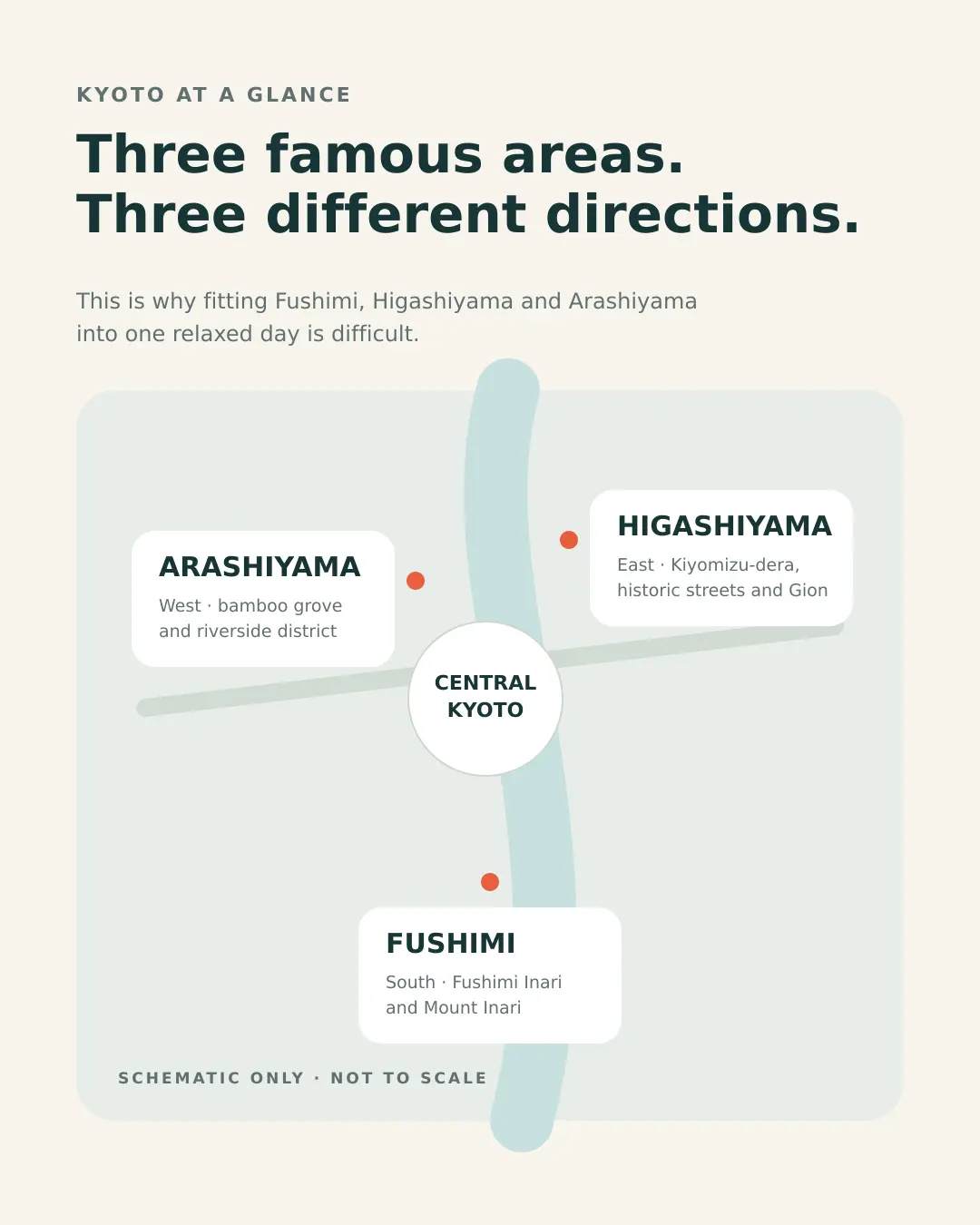
The problem is not the number of attractions. It is their geography.
- Fushimi Inari lies south of central Kyoto.
- Kiyomizu-dera sits in the eastern Higashiyama area, uphill from the nearest major rail connections.
- Arashiyama is on Kyoto’s western edge.
On a map, all three appear to sit within the same city. In practice, combining them means traveling from south Kyoto to east Kyoto and then across to west Kyoto.
Kyoto’s official tourism guide recommends the JR Nara Line for Kyoto Station to Fushimi Inari; the journey to JR Inari Station takes about nine minutes. It recommends the JR Sagano Line for Arashiyama, with rapid services reaching Saga-Arashiyama from Kyoto Station in about 11 minutes. Those train times are short, but they do not include getting to the station, waiting, transfers or walking to the attractions. Kyoto’s official Fushimi access guidance and Arashiyama access guidance explain the rail connections.
Kiyomizu-dera is the awkward middle point. It is not directly beside a train or subway station, and the final approach involves a walk uphill. Kyoto’s tourism authority also warns that obvious bus routes through Higashiyama can become congested and recommends mixing trains, subway and walking where practical. Kyoto Higashiyama access guidance
The fastest realistic DIY order
For most independent visitors, the most practical sequence is:
Fushimi Inari → Kiyomizu-dera → Arashiyama
This order uses Fushimi Inari’s flexible early-morning access, reaches Kiyomizu-dera after its 6:00 a.m. opening and leaves the least time-sensitive district—Arashiyama—for the afternoon.
It does not produce the quietest possible Arashiyama experience. By the time you arrive, the Bamboo Grove and central streets will usually be busy. That is the principal compromise.
6:30 a.m: Start at Fushimi Inari
Arrive around 6:30 a.m. and allow approximately 90 minutes.
That is enough time for:
- The main shrine buildings.
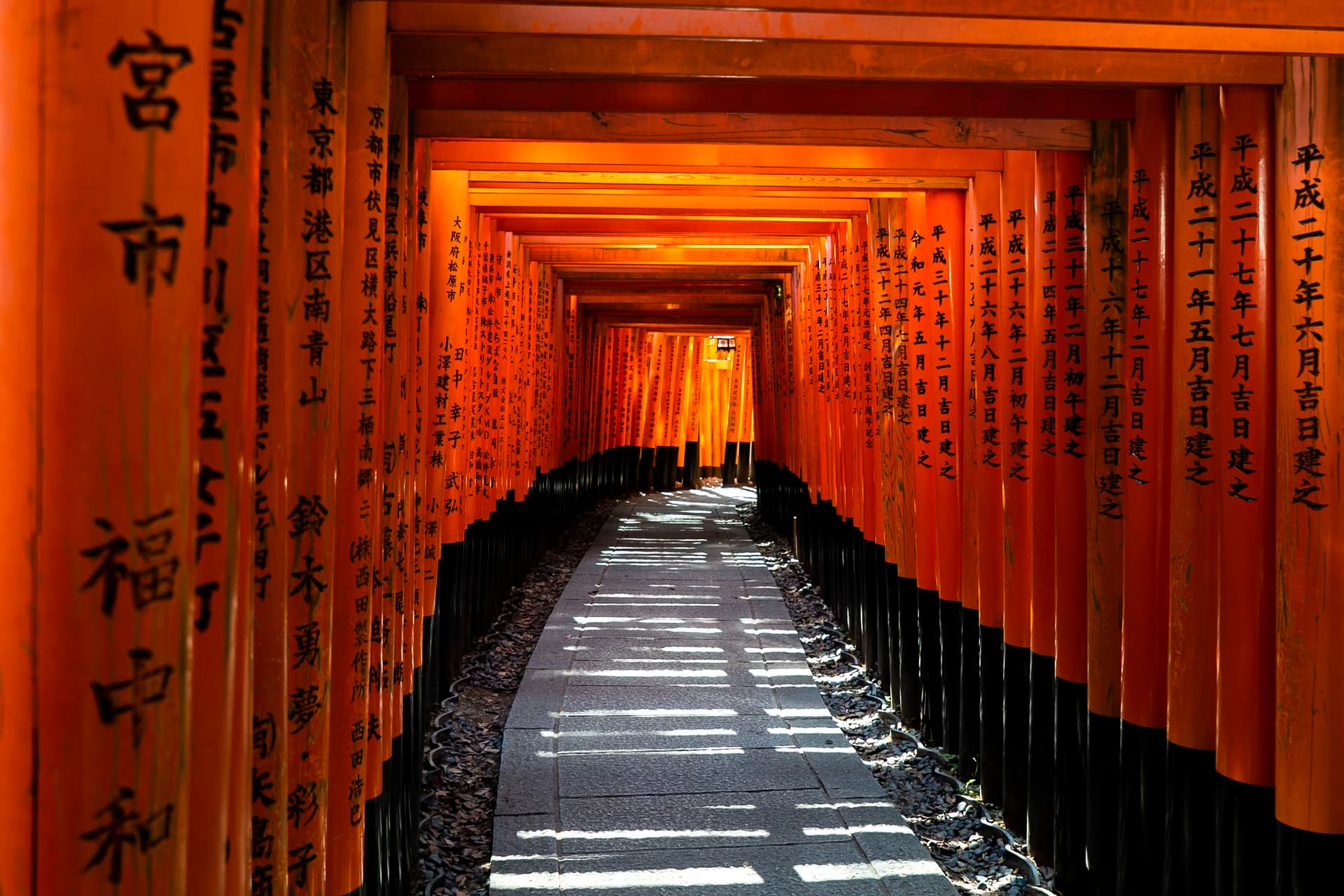
- The lower Senbon Torii corridors.
- A measured walk beyond the most photographed gates.
- A return to the station without running.
It is not enough time for the full Mount Inari circuit. A longer mountain visit can take roughly 2.5–3 hours depending on your pace and stops. If completing the circuit is important, do not attempt this three-area itinerary.
Fushimi Inari’s official site recommends public transport because the surrounding parking areas become crowded. JR Inari Station is immediately beside the main approach, while Keihan Fushimi-Inari Station is approximately a five-minute walk away. Official Fushimi Inari access information
What time should you leave Fushimi Inari?
Aim to be heading toward the station by 8:00 a.m. If you are still climbing at 8:00, decide whether to turn around or remove Arashiyama. Trying to recover lost time by rushing through the shrine is usually a sign that the day has become overpacked.
8:00 a.m: Travel to Kiyomizu-dera
Allow 45–60 minutes between leaving Fushimi Inari and reaching the Kiyomizu-dera entrance.
A common independent approach is to use the Keihan Railway toward Kiyomizu-Gojo and continue on foot, by bus or by taxi. The final section is uphill, so the fastest route on a map may not feel fast with children, luggage or limited mobility.
Do not build the schedule around the vehicle journey alone. Your allowance must include:
- Walking back to the station.
- Waiting for the train.
- The final uphill approach.
- Congestion around the temple streets.
- Time to locate the correct entrance.
9:00 a.m: Visit Kiyomizu-dera
Allow 75–90 minutes inside the temple complex.
Kiyomizu-dera opens at 6:00 a.m., while closing time changes by season and during special evening openings. Confirm the current schedule on the official Kiyomizu-dera calendar.
By arriving around 9:00 a.m., you miss the quietest opening hour but still retain enough time for the main hall, viewing areas and temple grounds. Avoid scheduling a timed reservation immediately afterward because queues and congestion can change the pace of the visit.
10:30 a.m: Walk through Sannenzaka and Ninenzaka
These historic streets are directly connected to the Kiyomizu-dera visit, so it would make little sense to rush past them. Allow 45–60 minutes for the downhill walk, photography and a limited number of shop stops.
If you want a slow breakfast, extensive shopping or additional Higashiyama temples, Arashiyama should move to another day.
11:30 a.m: Eat an early lunch
Reserve 45–60 minutes for lunch near Higashiyama, Gion or a convenient station connection.
Avoid a restaurant that requires you to cross the city or wait in a famous queue. The purpose of an early lunch is to protect the afternoon—not to add another attraction disguised as a meal.
Leave the eastern side of Kyoto around 12:30 p.m.
12:30 p.m: Cross Kyoto to Arashiyama
Allow approximately 60–75 minutes from the Higashiyama area to central Arashiyama, including walking and transfers.
There are several viable routes depending on where you finish lunch. In many cases, the most reliable strategy is to reach a useful rail connection rather than remain on a slow cross-city bus. Kyoto’s official guide encourages visitors to combine trains and subway with buses instead of defaulting to buses for every journey. Getting around Kyoto
Check live directions before leaving lunch. A delayed bus, missed connection or seasonal crowd can move your Arashiyama arrival well beyond the planned time.
1:45 p.m: Spend the afternoon in Arashiyama
Allow three to three and a half hours for a focused version of Arashiyama:
- Arashiyama Bamboo Grove — 30–45 minutes.
- Tenryu-ji and its garden — 60–75 minutes.
- Togetsukyo Bridge and the riverside — 45–60 minutes.
- Buffer for walking, tickets and a short refreshment stop.
This is not enough time for every major Arashiyama attraction. Do not add the Monkey Park, Sagano Scenic Railway and several distant temples unless you remove something else.
The trade-off: Arashiyama will probably be crowded
Most itinerary advice recommends visiting the Bamboo Grove early. On this route, that is impossible because Fushimi Inari receives the early slot.
Kyoto publishes congestion forecasts and selected live-camera information for popular sightseeing areas. Check the Kyoto Travel Congestion Forecast before committing to the order. If Arashiyama is predicted to be exceptionally busy in the afternoon, reverse the itinerary or divide it over two days.
Is the DIY itinerary actually doable?
Yes, but only with clear limits.
The plan works if you:
- Start by 6:30 a.m.
- Visit only Fushimi Inari’s lower shrine route.
- Limit Kiyomizu-dera and the historic streets to approximately 2.5 hours combined.
- Eat an efficient lunch.
- Accept afternoon crowds in Arashiyama.
- Finish with the Bamboo Grove, Tenryu-ji and river area rather than every attraction.
- Are comfortable walking for much of a 10–11-hour day.
It stops working if you:
- Begin after 8:00 a.m.
- Complete the full Mount Inari circuit.
- Add Gion, Nishiki Market or Kinkaku-ji independently.
- Reserve a long lunch.
- Depend on perfect bus connections.
- Travel with large luggage.
- Need frequent rest periods or step-free access.
What will you sacrifice by seeing all three in one day?
A quiet Arashiyama visit
You will arrive after the best early-morning window. The Bamboo Grove may feel more like a busy attraction than a peaceful landscape.
The full Fushimi Inari experience
The itinerary covers the lower shrine and gates, not the complete mountain circuit.
A slower Higashiyama day
You can see Kiyomizu-dera and its historic approach, but you will not have much room for tea houses, additional temples or an unplanned afternoon in Gion.
Resilience when something goes wrong
A missed train or long queue can remove 30–45 minutes from Arashiyama. There is little spare time to absorb delays.
The easier option: take an organized Kyoto highlights tour
If your priority is covering Kyoto’s major sights in one day—not controlling how long you spend at each one—an organized coach tour is a reasonable alternative.
The PERFECT KYOTO 1-Day Bus Tour currently combines:
- Kiyomizu-dera.
- Sanjusangendo.
- Arashiyama and the Bamboo Grove.
- Tenryu-ji.
- Kinkaku-ji.
- Fushimi Inari.
According to the current listing, it lasts approximately 8–9 hours, departs near Kyoto Station and returns to the same meeting area. Coach transport, a professional English-speaking guide, multilingual audio guidance and specified attraction admissions are included. A lunch option may be available depending on the booking selected. Check current inclusions, price and availability.
At the time this article was checked, the tour displayed a 4.9 rating from more than 16,000 combined Viator and Tripadvisor reviews. Ratings, itinerary order, inclusions and availability can change, so verify the live listing before booking.
Important limitations of the tour
This is not a private or slow-travel experience.
The listing states that:
- The maximum group size is 42 travelers.
- The itinerary includes considerable walking, hills and stairs.
- It is not wheelchair accessible.
- Travelers should have a moderate level of physical fitness.
- Hotel pickup and drop-off are not included.
- Late arrivals cannot join midway.
- The order or included stops may change because of traffic, weather, closures or operational conditions.
The tour solves the transport-planning problem. It does not eliminate crowds, walking or a fast pace.
DIY itinerary versus guided coach tour
Factor | Independent itinerary | Organized coach tour |
Flexibility | High | Low |
Transport planning | You manage every connection | Organized for you |
Time at each stop | You decide within the day’s limits | Fixed by the tour schedule |
Number of highlights | Best limited to the three main areas | Adds several major temples |
Early access | Fushimi Inari can be visited early | Fixed meeting and departure time |
Historical context | Requires your own research | Guide and audio guidance included |
Group environment | Your own party | May include a large group |
Mobility demands | Can be adapted somewhat | Significant walking; listed as not wheelchair accessible |
Best for | Independent travelers who value control | First-time visitors prioritizing coverage and convenience |
Choose the DIY route if…
- You want to start before most organized tours.
- You value flexibility more than the number of attractions.
- You are confident using Kyoto’s rail network.
- You may remove a stop if the day becomes tiring.
- You want to choose your own meals and pace.
Choose the guided tour if…
- You have only one sightseeing day in Kyoto.
- You want to see several headline attractions.
- You prefer not to plan multiple transfers.
- You value transport convenience and commentary.
- You are comfortable with a fixed schedule and group setting.
Convenience option: Check the Kyoto one-day tour’s current schedule and availability.
A better alternative: divide the route over two days
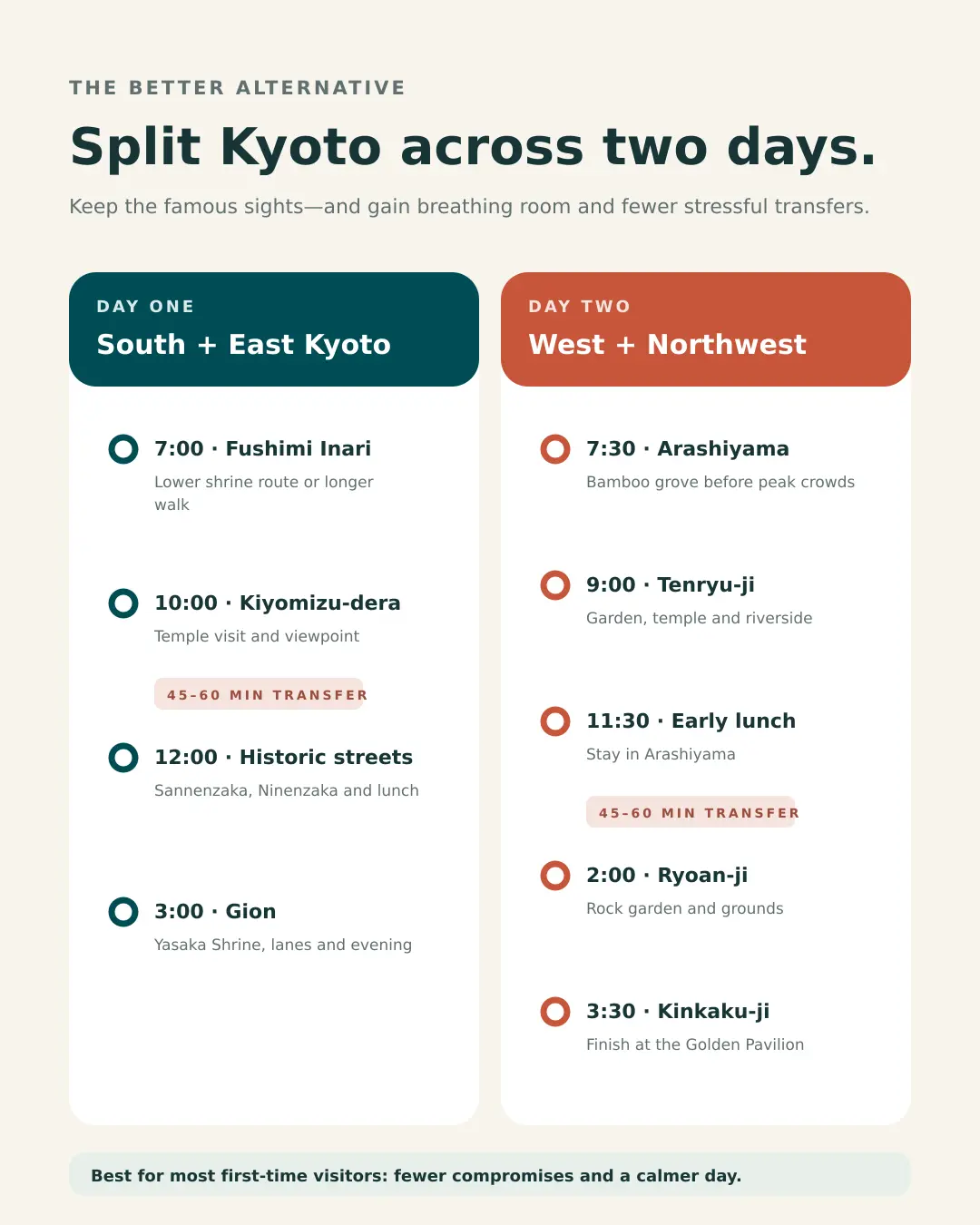
If your schedule allows, this is the more comfortable structure:
Day 1: Fushimi Inari and eastern Kyoto
- Fushimi Inari early morning.
- Kiyomizu-dera.
- Sannenzaka and Ninenzaka.
- Yasaka Shrine.
- Gion in the late afternoon or evening.
Day 2: Arashiyama and northwestern Kyoto
- Arashiyama Bamboo Grove early morning.
- Tenryu-ji.
- Togetsukyo Bridge.
- Ryoan-ji.
- Kinkaku-ji.
This arrangement gives both Fushimi Inari and Arashiyama an early start and removes the midday journey across Kyoto.
If you have three days, use our complete three-day Kyoto itinerary, which groups the city into eastern, western and south-central sightseeing days.
How to make the one-day route less exhausting
Travel without luggage
Store large bags at your hotel or a suitable station facility. Carrying luggage through shrine paths, uphill streets and crowded trains will slow every part of the day.
Use rail for the long sections
Kyoto’s official guide identifies JR access for both Fushimi and Arashiyama. Buses remain useful for local connections, but they should not automatically be your first choice for every cross-city movement.
Consider one strategic taxi
A taxi can simplify the awkward connection around Kiyomizu-dera, particularly for a small group. It will not necessarily beat rail across the entire city when roads are congested.
Check crowds before fixing the order
Use Kyoto’s official congestion forecast. During cherry-blossom season, autumn foliage, weekends and Japanese public holidays, remove an optional stop or use the two-day plan.
Decide your priorities before leaving
Rank the three areas. If the schedule slips, remove your third priority instead of making every visit progressively shorter.
Frequently asked questions
Can you visit Fushimi Inari and Arashiyama on the same day?
Yes, but the two attractions sit on opposite sides of Kyoto. Visit one early, allow roughly an hour for the cross-city connection and limit the number of additional attractions. For a less rushed experience, place them on separate days.
Which should you visit first: Fushimi Inari or Arashiyama?
For this three-area itinerary, start at Fushimi Inari because its lower shrine route works well early and connects more naturally toward eastern Kyoto. If the Bamboo Grove is your highest priority, start in Arashiyama and accept a later, busier Fushimi Inari visit.
How long do you need at Fushimi Inari?
Allow approximately 60–90 minutes for the main shrine and lower torii-gate route. Allow roughly 2.5–3 hours for a longer mountain circuit. The one-day itinerary only works with the shorter version.
How long do you need at Kiyomizu-dera?
Allow about 75–90 minutes for the temple complex, plus time for the uphill approach. Add another 45–60 minutes if you want to walk through Sannenzaka and Ninenzaka without rushing.
How long do you need in Arashiyama?
Allow at least three hours for the Bamboo Grove, Tenryu-ji and Togetsukyo Bridge area. A fuller visit including the Monkey Park, scenic railway or more distant temples requires most of a day.
Is the organized Kyoto tour suitable for everyone?
No. The current listing describes substantial walking, stairs and hills, requires moderate physical fitness and states that the tour is not wheelchair accessible. Check the current accessibility details directly with the operator before booking.
Is one day enough for Kyoto?
One day is enough for a highlights tour, but not for a complete Kyoto experience. If possible, stay for at least two or three full sightseeing days and group attractions by area.
Final verdict
Fushimi Inari, Kiyomizu-dera and Arashiyama can fit into one day, but the schedule is demanding and the attractions will not receive equal attention.
Choose the independent itinerary if you want flexibility and are willing to limit the lower-priority stops. Choose the guided coach tour if your priority is seeing several famous landmarks without solving the transport logistics yourself.
If you have two or more days, separate Arashiyama from Fushimi Inari and Higashiyama. Kyoto becomes much more enjoyable when the itinerary follows the city’s geography instead of fighting it.
Data check
Based on the research done by Travinora team, checked August 2026.

Bookable now
PERFECT KYOTO 1-Day Bus Tour
★ 4.8 (733) · 8.5 hr · from $126
Book this experience →